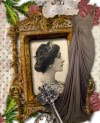
Horchow was the first free-standing luxury catalog business in the United Stated not attached to a large store. The founder, Roger Horchow, published his first catalog in 1973, after graduating from Yale and working in retail at Neiman Marcus. He sold the catalog business to Neiman Marcus in 1988 and went on to become a Tony award winning Broadway producer.
Some famous clients include the Royal Family of Monaco, several Kennedys, Liza Minnelli and Robert Redford, who once ordered a gadget to kill bugs on his ranch.
Pictured is a dog bonbonniere from an early catalog along with two catalog covers from the late 1970's.
Showing posts with label Limoges Box. Show all posts
Tuesday, June 18, 2013
Wednesday, July 4, 2012
A Cornucopia of Clasps
Almost every Limoges Box has a decorative clasp that matches the theme of the piece, as well as the banding and serves a purpose...to keep the box closed with a 'snap'. These clasps come in a wide array of styles from simple round buttons, bows and hearts to the very elaborate, and all are slightly bent to catch the metal banding and close securely. Some collectors focus on the clasp and will purchase a piece simply because it has an unusual clasp.
This clasp is made from 24k gold plated sterling silver from Faberge and the design is the Romanov Double Eagle.
The French farmhouse theme is repeated here with this hen clasp from a box featuring a rooster.
Friday, May 25, 2012
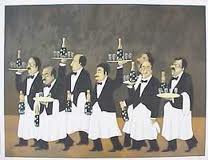
Guy Buffet & Those Whimsical French Waiters
This Limoges box mixes the elegance of a fine work of art with the whimsical humor reminiscent of Mr. Buffet's quirky paintings.
Labels:
Cork,
French Waiters,
Guy Buffet,
Limoges Box,
Wine
Wednesday, October 12, 2011
How to open your Limoges Box
How to Open Your Limoges Box
Before attempting to open your Limoges box, please carefully read these instructions:
- Make sure clasp on front of metal band is facing you.
- Place thumbnails in between the two halves of the metal bands.
- Gently pull thumbnails in opposite directions until box opens. The clasp is decorative only and does not cause the box to snap open or closed.
- NEVER pull on the porcelain to open the box. NEVER pull on the clasp. NEVER try to force the box open. NEVER use a knife blade or sharp object to open the box - it may scratch the rim or puncture your hand!
- Once opened, never pressure the hinge to go backwards if there is resistance... that is designed into the box. NEVER slam the box closed, as this may cause the porcelain to crack or break.
- Invariably, your friends will want to open your boxes, and that's generally asking for trouble. It's best if you open the box for your friend, and hand it to him or her open.
Labels:
clasp,
hinge,
Limoges Box,
metal bands
Saturday, April 3, 2010
Sevres
Sevres porcelain is widely known to be both the French porcelain of royalty and the royal porcelain of France.
King Louis XV, known as the most notable art patron in modern history, became the major customer and joined as a shareholder of the factory in 1745. The factory had a goal to deliver a superior product in order to compete with the early Meissen, Berlin, and other continental porcelains. By 1752, the king became the major shareholder. He deemed that this porcelain to be designated as royal, or Manufacturer Royale du Porcelaine. He conducted annual sales from his palace grounds at Versailles, encouraged his court and other royalty to buy his product, and even restricted other porcelain factories from using gilding or colored grounds on their porcelains.When the operation ran into financial troubles in 1759, King Louis XV acquired the factory as royal property. The king took over the manufacturing operations, and considered himself the principal client and salesperson of these extraordinary porcelain creations. The factory was moved to the village of Sevres southwest of Paris; a location near to the palace of Versailles and close to the home of Madame de Pompadour at the Chateau de Bellevue. From that time the porcelain became officially known as Sevres porcelain.
The earliest Sevres had graceful shapes and soft colors. Sevres pieces produced from 1750 to 1770 were decorated with brilliant colors and heavy gilding. Many of these pieces had richly colored backgrounds and white panels painted with birds, flowers, landscapes, or people. Sevres is also noted for its fine figurines of biscuit (unglazed porcelain). The Sevres factory introduced hard-paste porcelain in the 1770s and soft-paste porcelain production ended in 1804.
The artists decorating many modern day Limoges boxes were inspired by the early intricate patterns and elaborate gilding of the Sevres era, thus the creation of pattern commonly known as Sevres. Pictured is a modern example of a Limoges box from Limoges Imports - a footed urn. Also pictured is an example of what may have inspired the pattern: a Sevres Beau Bleu Dejeuner c1780, which sold for $6000 at Christies, New York in May 2008.
Labels:
King Louis XV,
Limoges Box,
Madame de Pompadour,
Sevres,
Versailles
Saturday, October 24, 2009
A French Potpourri
In early 17th Century France fresh herbs and flowers were gathered and used to make potpourri which was set out in special pots to perfume the air in their palaces and cottages. Potpourri is made by mixing oils, leaves, and/or dried flowers. When prepared, the mixture is enclosed in a bottle or jar, and allowed to sit for several weeks. During this time, the potpourri may smell rotten, however it soon improves.
The word "pot" in French has the same meaning
as it does in English, while the word "pourri" means rotten. The term "rotten pot" probably refers to some fermenting which may enhance the natural fragrances of a potpourri's
ingredients.
In ceramics manufacturing, a potpourri vase is a vase specifically designed for holding potpourri. In the traditional designs a potpourri container is provided with a pierced fitted lid, through which the scent may slowly diffuse. This pretty potpourri diffuser is a trunk shaped Limoges Box made by Chamart with a porcelain top hand decorated with a pansy design and a pierced metal bottom in which to place scented potpourri.
Labels:
Chamart,
fragrances,
France,
Limoges Box,
Potpourri
Thursday, October 1, 2009
France: The Oyster Capitol of the World

France and oysters go way back. Since Roman times, the coast of France has been the place of choice where prime oysters can be found. From North to South there are seven distinct growing regions: Normandy, North-Brittany, South-Brittany, West-Central, Marennes-Oléron, Arcachon, and the Mediterranean. Although some of these areas are far more famous than others, they all produce excellent oysters.
The European oyster (Ostrea edulis) is the native
The coast of France offers fantastic oyster experiences. Virtually anywhere along the
French coastline (including the Mediterranean) delicious oysters are served. Much like French wine growing areas, oyster cultivation areas are
often informally refered to as "crus". The best
part about the French coast is, however, the price of oysters. They usually cost half of what is charged in Paris.
As oysters go, the French have long been the undisputed leader in all of Europe. In France more than 143,000 tons of oysters are produced and eaten every year. It may take only about three seconds to swallow an oyster, but it takes three to four years to raise one. Like wine, oysters have different flavors depending on the region where they are raised.
Labels:
France,
Hotel de Paris,
Limoges Box,
Oysters
Thursday, September 24, 2009
Caviar Kaspia

A landmark at the Place de La Madeleine, since 1927, dining at Caviar Kaspia has been synonymous with luxurious pleasure and refinement.
Today this Parisian landmark has become the meeting point for writers, artists, food connoisseurs, fashion designers, influential style icons and Hollywood movie stars such as Valentino, Anna Wintour, Gwyneth Paltrow, Katie Holmes, Mick Jagger, Keanu Reeves and David & Victoria Beckham, who appreciate edible luxury of the finest quality.
woodwork and old pictures, porcelains and art objects. The menu is an invitation to taste authentic flavors from the sea and from the land. In addition to caviar as the specialty of the house, a rare assortment of smoked fish, wild salmon, and duck Foie Gras are served. Vodka, the drink of choice at Kaspia, allies itself perfectly with caviar and over 100 different varieties are available.
The caviar jar pictured is actually a Limoges Porcelain Box from Eximious of London.
Labels:
Caviar,
Caviar Kaspia,
France,
Limoges Box,
Paris,
Place de La Madeleine
Thursday, September 3, 2009
Cherry Clafoutis

If you mix plenty of unpitted black cherries into what may best be described as a slightly thickened crêpe batter, you will have the makings of a traditional clafoutis (a type of batter cake from the farm country of southern France). The recipe is old but not ancient, probably dating from around the 1860s. The unusual name (sometimes spelled clafouti) comes from clafir, a dialect word meaning "to fill".
According to Larousse Gastronomique, when the Académie Française defined clafoutis as a "sort of fruit flan", inhabitants of Limoges protested, forcing the institution to change the definition to the more acceptable "cake with black cherries". Black cherries are the meatiest, juiciest, and sweetest of all cherries and they're left unpitted because the pits are thought to enhance the flavor of the batter with a perfume faintly reminiscent of almonds. Whole cherries are also less likely to bleed into the batter.
A perfect clafoutis has a deep golden brown crust on both the bottom and the top. And the only way to achieve this is to bake
it in a sufficiently hot oven. At too low a temperature, the flour
separates from the rest of the batter, settling at the bottom of the
pan and leaving a pale custard behind.
Though black cherries are the classic addition, clafoutis is made
today with all kinds of fruit.
Julia Child's Cherry Clafouti Recipe
1½ hours 10 min prep
SERVES 6 -8 , 4 for breakfast
1 1/4 cups milk
2/3 cup sugar, divided
3 eggs
1 tablespoon vanilla
1/8 teaspoon salt
1/2 cup flour
3 cups cherries, pitted
powdered sugar, for garnish
Preheat oven to 350 degrees F.
Using a blender, combine the milk, 1/3 cup sugar, eggs, vanilla, salt and flour, and blend.
Lightly butter an 8-cup baking dish, and pour a 1/4-inch layer of the blended mixture over the bottom. Set remaining batter aside.
Place dish into the oven for about 7-10 minutes, until a film of batter sets in the pan but the mixture is not baked through. Remove from oven (but don’t turn the oven off, yet).
Distribute the pitted cherries over the set batter in the pan, then sprinkle with the remaining sugar. Pour the remaining batter over the cherries and sugar.
Bake in the preheated oven for 45 to 60 minutes, until the clafouti is puffed and brown and a knife inserted into the center comes out clean.
Sprinkle with powdered sugar and serve warm.
According to Larousse Gastronomique, when the Académie Française defined clafoutis as a "sort of fruit flan", inhabitants of Limoges protested, forcing the institution to change the definition to the more acceptable "cake with black cherries". Black cherries are the meatiest, juiciest, and sweetest of all cherries and they're left unpitted because the pits are thought to enhance the flavor of the batter with a perfume faintly reminiscent of almonds. Whole cherries are also less likely to bleed into the batter.
A perfect clafoutis has a deep golden brown crust on both the bottom and the top. And the only way to achieve this is to bake
it in a sufficiently hot oven. At too low a temperature, the flour
separates from the rest of the batter, settling at the bottom of the
pan and leaving a pale custard behind.
Though black cherries are the classic addition, clafoutis is made
today with all kinds of fruit.
Julia Child's Cherry Clafouti Recipe
1½ hours 10 min prep
SERVES 6 -8 , 4 for breakfast
1 1/4 cups milk
2/3 cup sugar, divided
3 eggs
1 tablespoon vanilla
1/8 teaspoon salt
1/2 cup flour
3 cups cherries, pitted
powdered sugar, for garnish
Preheat oven to 350 degrees F.
Using a blender, combine the milk, 1/3 cup sugar, eggs, vanilla, salt and flour, and blend.
Lightly butter an 8-cup baking dish, and pour a 1/4-inch layer of the blended mixture over the bottom. Set remaining batter aside.
Place dish into the oven for about 7-10 minutes, until a film of batter sets in the pan but the mixture is not baked through. Remove from oven (but don’t turn the oven off, yet).
Distribute the pitted cherries over the set batter in the pan, then sprinkle with the remaining sugar. Pour the remaining batter over the cherries and sugar.
Bake in the preheated oven for 45 to 60 minutes, until the clafouti is puffed and brown and a knife inserted into the center comes out clean.
Sprinkle with powdered sugar and serve warm.
Labels:
Cherries,
Cherry Clafoutis,
French Desserts,
Julia Child,
Limoges Box
Friday, July 3, 2009
The French Baguette
Here we have a porcelain example of that sinfully
The real baguette is a small pleasure and a huge part of French culture. France eats approximately 30 million baguettes a day. Wow! (that's a half a baguette for everyone every day).
What makes a great baguette?
The first sign of quality is a hard crust of a rich, dark caramel color. A flimsy crust, a pale, straw yellow color and an underside marked by tiny dots all indicate that the bread has been cooked in an industrial oven often from frozen dough.
The inside (or "mie" in French) of a good baguette should be a creamy color with large irregular air holes. The industrial loaf, on the other hand, will be cotton white, with tiny, regular air holes.
The texture of a good baguette should be moist and slightly chewy with a full, almost nutty flavor. The industrial version is cottony, tasteless and dry.
Thursday, June 25, 2009
Hôtel de Paris

There are some exceptional places which one day cease to be merely an address and become a legend. The Hôtel de Paris is one of them.
This sumptuous palace is situated on the Golden Square of the Place du Casino and was the first hotel built in Monte Carlo in 1864. Russian Tsars, the Duke of Windsor and Winston Churchill stayed there to enjoy the splendour of the hotel itself and the stunning views of the azure blue sea.This Limoges Box captures the elegance and ambiance of an European breakfast as well as the white glove service that one would find at such a sophisticated and grand setting.
Labels:
Hotel de Paris,
Limoges Box,
Monte Carlo
Thursday, June 18, 2009
A Taste of Paris

A heavenly selection of
teas, coffees and pastries from around the world can be found at Cafe Verlet, a traditional French Cafe and coffee emporium in the heart of Paris. Verlet, in business since 1880, is situated near the Louvre and the Palais-Royal.This Limoges Box appears to be a French Apricot Tart baked to perfection. Below is Verlet's recipe for a similar
Apricot Tart provided by Epicurious.
Apricot Tart
For pastry
8 tablespoons (4 ounces; 12 g) unsalted butter, melted and cooled
1/2 cup (100 g) sugar
1/4 teaspoon pure almond extract
1/4 teaspoon pure vanilla extract
1/2 teaspoon fine sea salt
1 1/4 cups plus 1 tablespoon (180 g) unbleached all-purpose flour
2 tablespoons finely ground unblanched almonds
For filling
1/2 cup (25 cl) crème fraîche or heavy (whipping) cream
1 large egg lightly beaten
1/2 teaspoon pure almond extract
1/2 teaspoon pure vanilla extract
2 tablespoons full-flavored honey, such as lavender
1 tablespoon superfine flour, such as Wondra
About 1 1/2 pounds (750 g) fresh apricots, pitted and halved (do not peel)
Confectioners' sugar, for garnish
Preparation
Preheat the oven to 350°F (175°C).
Butter the bottom and sides of a 9-inch (23cm) fluted tart pan with removable bottom. Set aside.
Make the pastry:In a large bowl, combine the melted butter and the sugar, and using a wooden spoon, stir to blend. Add the remaining ingredients and stir to form a soft, cookie-like dough. Transfer the dough to the center of the buttered pan. Using the tips of your fingers, evenly press the pastry along the bottom and up the sides of the pan. The pastry will be quite thin.
Place the pan in the center of the oven and bake unitl the dough is slightly puffy and set, 12 to 15 minutes. Sprinkle the ground almonds over the bottom of the crust. (This will prevent the crust from becoming soggy.)
Meanwhile make the filling: In a medium-size bowl, combine the crème fraîche, egg, extracts and honey and whisk to blend. Whisk in the flour.
Pour the filling evenly over the pastry. Starting just inside the edge of the pan, neatly overlap the halved apricots, cut side up, at an angle. Arrange in two or three concentric circles, working toward the center. Fill in the center with the remaining apricots.
Place the tart pan on a baking sheet. Place the baking sheet in the center of the oven and bake until the filling is firm and the pastry is a deep golden brown, 55 to 60 minutes. The apricots will shrivel slightly. Remove from the oven and immediately sprinkle with confectioners' sugar. Place the tart on a rack to cool. Sprinkle again with confectioners' sugar just before serving.
Labels:
Apricot Tart,
Cafe Verlet,
Epicurious,
Limoges Box,
Paris
Thursday, June 11, 2009
Jardin de Paris
This Limoges Box depicts the famous poster
by Henri Toulouse-Lautrec that advertised
the debut of Jane Avril at the Jardin de Paris,
a café-concert on the Champs-Elysées. The
daughter of a demi-mondaine and an Italian
count, Jane Avril grew up poor, beaten, and
disturbed. She began her career as a dancer
at the Moulin-Rouge in 1889, developing a
relatively refined style that contrasted with
the vulgar exhibitionism of La Goulue.
A publicity photo of Avril performing
a high kick from the quadrille is thought
to have served as Lautrec's model for the
poster's preparatory oil sketch.
This piece, from Porcelaine Pierre Arquie,
is a limited
and numbered edition and inside the box
'Jardin de Paris' is painted.
Saturday, June 6, 2009
The Retailers - Eximious of London

The word Eximious is defined as "excellent, distinguished & eminent".
In the 1980's, Josephine Louis founded a charming and elegant shop while she lived in England which she called Eximious. Ms. Louis was so inspired by this little shop which became famous for gifts & monogrammed accessories that she decided to open a catalogue and shop in the United States. Eximious of London has become synonymous with the understated good taste of British traditions.At the heart of the catalogue, is the extensive Limoges collection. Eximious commissions artisans in Europe to produce unique and visually charming pieces that truly reflect a commitment to excellence.
It is with great sadness to report that on the Eximious website it is noted that they are going out of business.
Labels:
Catalogue,
England,
Eximious of London,
Josephine Louis,
Limoges Box
Tuesday, June 2, 2009
Love Those Fruits & Veggies
A Parisian Farmer's Market of delectable fruits and vegetables at their peak makes a fascinating, rich & colorful display.
Here are some of my favorites: an artichoke, a shallot & an amazing purple plum. Bon Appetit!
Sunday, May 17, 2009
Rasberry Charlotte
Yes, it was the French that came up with this
delightful
dessert, as beautiful as it is tasty.
A Limoges box is pictured
preserved in porcelain by Chamart.
Try the easy recipe below, may not look as nice as the Limoges and certainly has more calories but is
sure to please!
Easy and Quick Recipe from Epicurious :
yield: Makes 6 servings
active time: 15 min
total time: 50 min
Ingredients
7 ounces savoiardi (crisp Italian ladyfingers)
1 tablespoon Cognac or other brandy
1 pint premium vanilla ice cream, melted
10 ounces frozen raspberries (not in syrup)
1 cup water
Rounded 1/4 cup sugar
1 1/2 teaspoons fresh lemon juice
3/4 cup chilled heavy cream
Equipment: a 7- to 8-inch soufflé dish
Preparation
Layer ladyfingers in soufflé dish. Stir Cognac into melted ice cream and pour evenly over cookies. Let stand 10 minutes.
Purée, raspberries with water, sugar, and lemon juice in a blender until smooth.
Beat cream with an electric mixer or a whisk until it just holds stiff peaks, then add 3/4 cup raspberry sauce and continue to beat until mixture holds soft peaks.
Lightly press on cookies with a spatula to compact slightly, then drizzle 1/2 cup raspberry sauce over them. Spread raspberry cream evenly on top and chill, covered, in freezer 30 minutes.
Serve charlotte with remaining raspberry sauce.
delightful
A Limoges box is pictured
preserved in porcelain by Chamart.
Try the easy recipe below, may not look as nice as the Limoges and certainly has more calories but is
sure to please!
Easy and Quick Recipe from Epicurious :
yield: Makes 6 servings
active time: 15 min
total time: 50 min
Ingredients
7 ounces savoiardi (crisp Italian ladyfingers)
1 tablespoon Cognac or other brandy
1 pint premium vanilla ice cream, melted
10 ounces frozen raspberries (not in syrup)
1 cup water
Rounded 1/4 cup sugar
1 1/2 teaspoons fresh lemon juice
3/4 cup chilled heavy cream
Equipment: a 7- to 8-inch soufflé dish
Preparation
Layer ladyfingers in soufflé dish. Stir Cognac into melted ice cream and pour evenly over cookies. Let stand 10 minutes.
Purée, raspberries with water, sugar, and lemon juice in a blender until smooth.
Beat cream with an electric mixer or a whisk until it just holds stiff peaks, then add 3/4 cup raspberry sauce and continue to beat until mixture holds soft peaks.
Lightly press on cookies with a spatula to compact slightly, then drizzle 1/2 cup raspberry sauce over them. Spread raspberry cream evenly on top and chill, covered, in freezer 30 minutes.
Serve charlotte with remaining raspberry sauce.
Labels:
Chamart,
French Desserts,
Limoges Box,
Rasberry Charlotte,
Recipe
Thursday, May 14, 2009
The Makers - Pierre Arquie - PPA
One of the few companies left in the heart of Limoges that produce genuine Limoges Boxes is PPA - Porcelaine Pierre Arquie, which was created in 1996. Mr. Arquie, the owner, along with his 11 collaborators
Labels:
caterpillar,
ladybug,
Limoges Box,
Pierre Arquie,
PPA
Thursday, May 7, 2009
The Makers - PV
The sweet teddy bear pictured here is representative of the atelier's attention to detail. Note the expression, the tiny stitches & how puffy the pillow looks.
Labels:
Limoges Box,
Parry Vieille,
PV,
teddy bear
Saturday, May 2, 2009
The Makers - La Vie en Rose
La Vie en Rose is a major manufacturer of Limoges Boxes that bears the same name as the 2007 Oscar winning movie featuring
The box featured here is a deep cobalt blue with a wonderful gold and platinum design in relief. A brass ring sits inside to hold the fluted pink glass perfume bottle which has a red cabochon glass stone in the brass filigree top. A rich red tassel hangs from a ring at the top making for a truly elegant presentation.
Labels:
Edith Pilaf,
France,
La Vie en Rose,
Limoges Box,
Marion Cotillard,
Saint Junien,
Site-Corot
Monday, April 27, 2009
The Makers - Chamart
Chamart was founded by Charles Martine in the early 1950's. The name is derived from a combination of Mr. Martine's first & last names. In 1965, Chamart designed a collection of Limoges Boxes for Tiffany & Co. which became immensely popular and introduced the American public to the Limoges box.
Labels:
Chamart,
Charles Martine,
Limoges Box,
Tiffany
Subscribe to:
Posts (Atom)